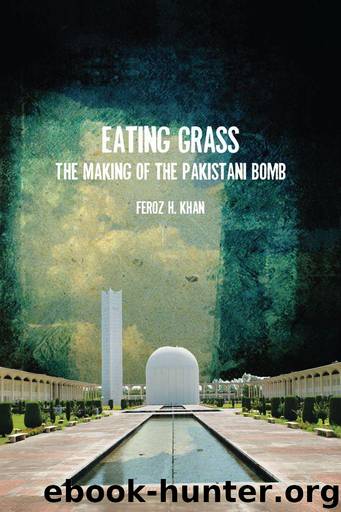
Eating Grass: The Making of the Pakistani Bomb by Feroz Khan
Author:Feroz Khan
Language: eng
Format: mobi, epub
ISBN: 9780226040813
Publisher: Stanford University Press
Published: 2012-11-07T07:00:00+00:00
14
The Nuclear Test Decision
At 3:45 p.m. on May 11, 1998, India conducted three nuclear tests, claiming the first test to be a two-stage thermonuclear experiment (Shakti-I), the second to be a fission test (Shakti-II), and the third, a subkiloton explosion to “validate new ideas and [the] subsystem” (Shakti-III).1 The declared yields were 43 kt, 15 kt, and 0.2 kt, respectively.2 In completing the tests, New Delhi announced its position as a de facto nuclear power, ensuring its national security.3
As the Pakistani nation received the news with shock, India celebrated. Indian Home Minister L. K. Advani brushed away his tears of joy long enough to warn Pakistan of the shift in the region’s strategic balance and how it may affect the Kashmir conflict. Another leader, Krishan Lal Sharma, asserted that India was “now in a position to take control of Azad Kashmir.”4 Some Hindu fundamentalists—clad in saffron robes—went even so far as to attempt to collect radioactive sands as sacred souvenirs from the test site.5
Back in Pakistan, General Jehangir Karamat ordered an immediate assessment of the situation, and by 5:00 p.m. all principal staff and key directors in General Headquarters (GHQ) were summoned to their posts. Major General Zulfiqar Ali Khan, who had replaced Ziauddin as Director General of the Combat Development Directorate (DGCD), called Samar Mubarakmand, then Member (Technical) Pakistan Atomic Energy Commission (PAEC), to evaluate the Indian test. Samar Mubarakmand said to the DGCD, “Congratulations!” but Major General Zulfiqar was in no mood for humor and remarked, “You are congratulating us on India’s tests?” Samar replied, “Yes, because now we would get a chance to do our own.”6
He went on to inform the DGCD (in the presence of the author) of the measurements taken at the nearest seismic station to India in Nilore. At first the data seemed to indicate that the tests were fission tests yielding between twelve and fifteen kt. However, as the PAEC further studied the data, it became clearer that India could not claim a thermonuclear test.7
Expecting a crisis to arise from this event, GHQ alerted all corps commands and began securing the country’s most sensitive areas. Specifically, Headquarters 12 Corps (Quetta) was tasked to secure the Ras Koh (Chagai) test site, and the Pakistan Air Force (PAF) was ordered to fly Combat Air Patrols (CAPs) covering all sensitive strategic locations. Air defense regiments of the army were alerted to monitor the entire air space. Clearly, Pakistan’s armed forces were making defensive preparations as if a war were imminent. Based on their long-held threat perceptions, they were bracing for the possibility of preventive strikes.8
During this time, Prime Minister Nawaz Sharif was visiting Uzbekistan, and after hearing the news, decided to cut his visit short and return to Pakistan the next day. Chief of the Army Staff (COAS) General Jehangir Karamat advised the prime minister that, upon his return, he should immediately call a meeting of the Defense Committee of the Cabinet (DCC) to examine the full spectrum of implications and bring in all stakeholders for a comprehensive discussion.
Download
Eating Grass: The Making of the Pakistani Bomb by Feroz Khan.epub
This site does not store any files on its server. We only index and link to content provided by other sites. Please contact the content providers to delete copyright contents if any and email us, we'll remove relevant links or contents immediately.
| Anthropology | Archaeology |
| Philosophy | Politics & Government |
| Social Sciences | Sociology |
| Women's Studies |
The Secret History by Donna Tartt(19301)
The Social Justice Warrior Handbook by Lisa De Pasquale(12224)
Thirteen Reasons Why by Jay Asher(8998)
This Is How You Lose Her by Junot Diaz(6955)
Weapons of Math Destruction by Cathy O'Neil(6369)
Zero to One by Peter Thiel(5867)
Beartown by Fredrik Backman(5839)
The Myth of the Strong Leader by Archie Brown(5552)
The Fire Next Time by James Baldwin(5506)
How Democracies Die by Steven Levitsky & Daniel Ziblatt(5271)
Promise Me, Dad by Joe Biden(5190)
Stone's Rules by Roger Stone(5130)
A Higher Loyalty: Truth, Lies, and Leadership by James Comey(5017)
100 Deadly Skills by Clint Emerson(4972)
Rise and Kill First by Ronen Bergman(4838)
Secrecy World by Jake Bernstein(4798)
The David Icke Guide to the Global Conspiracy (and how to end it) by David Icke(4771)
The Doomsday Machine by Daniel Ellsberg(4553)
The Farm by Tom Rob Smith(4550)
